Here are parts two and three of Vi Hart’s brilliant and dizzying exploration of the Fibonacci number, plant growth patterns, and the mathematics behind other cool, spiraly things.
More:
Spirals, Fibonacci, and Being a Plant


Here are parts two and three of Vi Hart’s brilliant and dizzying exploration of the Fibonacci number, plant growth patterns, and the mathematics behind other cool, spiraly things.
More:
Spirals, Fibonacci, and Being a Plant
Read more of this story at Slashdot.


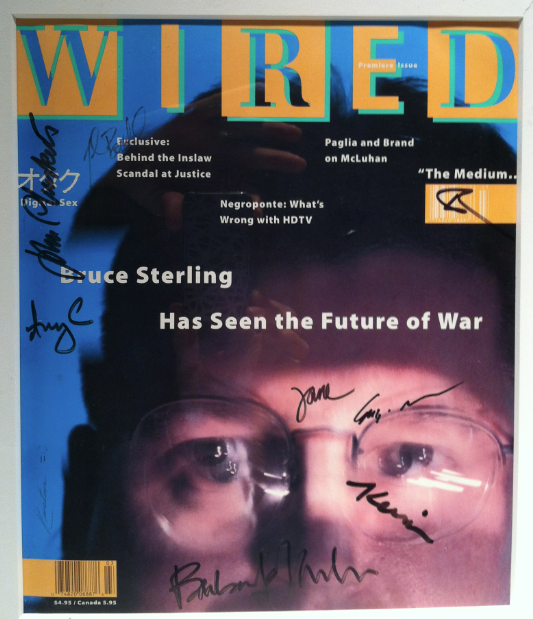
(image is a shot of my copy of the first Wired magazine, signed by our founding team)
I just read this NYT piece on the United States’ approach to unmanned warfare: Do Drones Undermine Democracy?. From it:
There is not a single new manned combat aircraft under research and development at any major Western aerospace company, and the Air Force is training more operators of unmanned aerial systems than fighter and bomber pilots combined. In 2011, unmanned systems carried out strikes from Afghanistan to Yemen. The most notable of these continuing operations is the not-so-covert war in Pakistan, where the United States has carried out more than 300 drone strikes since 2004.
Yet this operation has never been debated in Congress; more than seven years after it began, there has not even been a single vote for or against it. This campaign is not carried out by the Air Force; it is being conducted by the C.I.A. This shift affects everything from the strategy that guides it to the individuals who oversee it (civilian political appointees) and the lawyers who advise them (civilians rather than military officers).
It also affects how we and our politicians view such operations. President Obama’s decision to send a small, brave Navy Seal team into Pakistan for 40 minutes was described by one of his advisers as “the gutsiest call of any president in recent history.” Yet few even talk about the decision to carry out more than 300 drone strikes in the very same country.
Read the whole piece. Really, read it. If any article in the past year or so does a better job of displaying how what we’ve built with technology is changing the essence of our humanity, I’d like to read it.
For me, this was a pretty powerful reminder. Why? Because we put the very same idea on display as the very first cover story of Wired, nearly 20 years ago. Written by Bruce Sterling, whose star has only become brighter in the past two decades, it predicts the future of war with an eerie accuracy. In the article, Sterling describes “modern Nintendo training for modern Nintendo war.” Sure, if he was all seeing, he might have said Xbox, but still…here are some quotes from nearly 20 years ago:
The omniscient eye of computer surveillance can now dwell on the extremes of battle like a CAT scan detailing a tumor in a human skull. This is virtual reality as a new way of knowledge: a new and terrible kind of transcendent military power.
…(Military planners) want a pool of contractors and a hefty cadre of trained civilian talent that they can draw from at need. They want professional Simulation Battle Masters. Simulation system operators. Simulation site managers. Logisticians. Software maintenance people. Digital cartographers. CAD-CAM designers. Graphic designers.
(Ed: Like my son playing Call of Duty?)
And it wouldn’t break their hearts if the American entertainment industry picked up on their interactive simulation network technology, or if some smart civilian started adapting these open-architecture, virtual-reality network protocols that the military just developed. The cable TV industry, say. Or telephone companies running Distributed Simulation on fiber-to-the-curb. Or maybe some far-sighted commercial computer-networking service. It’s what the military likes to call the “purple dragon” angle. Distributed Simulation technology doesn’t have to stop at tanks and aircraft, you see. Why not simulate something swell and nifty for civilian Joe and Jane Sixpack and the kids? Why not purple dragons?
(Ed: Skyrim, anyone?!)
…Can governments really exercise national military power – kick ass, kill people – merely by using some big amps and some color monitors and some keyboards, and a bunch of other namby-pamby sci-fi “holodeck” stuff?
The answer is yes.
…Say you are in an army attempting to resist the United States. You have big tanks around you, and ferocious artillery, and a gun in your hands. And you are on the march.
Then high-explosive metal begins to rain upon you from a clear sky. Everything around you that emits heat, everything around you with an engine in it, begins to spontaneously and violently explode. You do not see the eyes that see you. You cannot know where the explosives are coming from: sky-colored Stealths invisible to radar, offshore naval batteries miles away, whip-fast and whip-smart subsonic cruise missiles, or rapid-fire rocket batteries on low-flying attack helicopters just below your horizon. It doesn’t matter which of these weapons is destroying your army – you don’t know, and you won’t be told, either. You will just watch your army explode.
Eventually, it will dawn on you that the only reason you, yourself, are still alive, still standing there unpierced and unlacerated, is because you are being deliberately spared. That is when you will decide to surrender. And you will surrender. After you give up, you might come within actual physical sight of an American soldier.
Eventually you will be allowed to go home. To your home town. Where the ligaments of your nation’s infrastructure have been severed with terrible precision. You will have no bridges, no telephones, no power plants, no street lights, no traffic lights, no working runways, no computer networks, and no defense ministry, of course. You have aroused the wrath of the United States. You will be taking ferries in the dark for a long time.
…Now imagine two armies, two strategically assisted, cyberspace-trained, post-industrial, panoptic ninja armies, going head-to-head. What on earth would that look like? A “conventional” war, a “non-nuclear” war, but a true War in the Age of Intelligent Machines, analyzed by nanoseconds to the last square micron.
Who would survive? And what would be left of them?
Who indeed.


Looking for a hotel near the Eiffel Tower, but not too familiar with your Parisian neighborhoods?
Google has unveiled a new feature for its “Hotel Finder” tool, allowing travelers to look for lodging near popular landmarks. The addition is perfect for those looking to narrow their hotel search by how long it takes to get to certain spots within a city. So whether you’re planning a vacation or a business trip, the feature makes it easy to find the best spot to spend the night.
Finding hotels by travel time is an extension of Google’s Hotel Finder tool, which debuted in July. Now, instead of just looking for hotels in a certain city, typing “Eiffel Tower” or “Empire State Building” will show you available hotels and prices in that area. You can also search by address.
Not into a 20-minute commute or want to walk to the landmark by foot? Select your travel-time and mode of transportation preferences, and Google’s Hotel Finder map will automatically update with suggested hotels.
Google noted in a blog post that the feature is currently “experimental” and that filtering by transit time is only available in certain cities, including New York, Niagara Falls (Canada), Las Vegas, Honolulu, Paris, London and Bangkok. These locations have “partnered with local transit agencies to integrate their data into Google Maps,” the site said.
Have you used Google’s Hotel Finder? Would you use this tool — and the new feature — to help you plan trips? Let us know in the comments.


Read more of this story at Slashdot.

You know that sinking feeling you have when there's too much on your plate? When you try to tackle your tasks by priority, but it feels like everything's important? Don't get overwhelmed—it's a problem that everyone faces at some point or another, and while it's difficult to skillfully juggle multiple priorities and competing responsibilities, it's not impossible. Here's how.
It just so happens that there's a career that focuses specifically on juggling competing tasks and priorities: These people are called project managers. And as luck would have it, I was a full time PM for many years, PMP-certified and everything. In that time, I learned a number of helpful tricks that can help you manage your workload at the office as well as your ever-growing list of to-dos at home, with your family, or with your friends. Here's how you can apply some of those techniques to your everyday life.
Photo by Josh S.
Even if everything on your plate is supposedto be equally important, you still need a way to break down which ones you spend your time on, and how you slice up your time. The first question you have to get past is whether or not everything really is of equal importance. Here are a couple of tips to help you cut through the fog and get a feel for how important your responsibilities and projects really are.
Photo by Lisa Stevens.
In order for your priorities to even matter, you need to have some sort of a personal productivity system in place to which you hold yourself accountable—and in which your priorities will actually matter. If you've got a tried and true system, great. If not,check out our guide to building one that's right for you.
The goal of your system, whichever you select, is to take away the need for you to waste time deciding what to work on next, even when you have a lot on your plate. I've found that David Allen's GTD framework is one of the most effective methods for me, mostly because it focuses on what you should do now and what your next actions should be, and it emphasizes getting your to-dos out of your head and into some system that will help you work. I've mentioned before that I manage my to-dos in ReQall, but there are plenty of other options, like previously mentioned Wunderlist, or if you work on a team, Asana, a collaborative tool we adore.
Whichever tool and productivity method you choose, dump your to-dos and projects into it as quickly as possible. Make sure it's something you'll actually return to and use frequently, and something that's easy to fit into your workflow, and you'll be successful. In the end, you want something easy to refer to, easy to enter tasks into, and that gives you a great view of all of the balls you have in the air at any time.
Photo by David Chico Pham.
When I was a project manager, one of the first things I learned to help me judge which projects were most important or needed the most attention is the "triple constraint," or a triangle with three equilateral sides. Each side represents the cost of the project, the scope of the project, and the time required to complete the project. None of the sides can be adjusted without making changes to the other two sides. The sides you're weakest in help determine the projects that need special attention. This holds true for all things, not just projects and project managers: If someone heaps more work onto you (scope), but insists that you finish in the same amount of time (time), you'll need more resources (cost) to get the job done.
For example, if you want to paint the spare room in time for out-of-town guests to stay over, you can't change the size of the job (scope), but you can control whether you buckle down and do it yourself overnight (time), or get someone else to do it for you while you do something else (cost). Here's how you can use these three principles to organize your everyday to-dos.
Photo by Mike Truchon/Shutterstock.
It's easy for us to toil away in obscurity, quietly hating our lives and our jobs and growing more frustrated with every passing minute. All the while, there may be a friend who's willing to help if we had only asked, or a boss who would be willing to help you out if you asked the right questions or gave them the right information.
We've talked about how difficult it can be to delegate, and how to delegate effectively in the past, but however you go about it, it's important to remember that you need to be assertive, not aggressive when asking for help, and you need to make your case with all of the data you have available. By now, you should have your priorities laid out and you have a good idea what you need. Use that information to ask for help and prove you need it, and remember, don't be upset if your friends, boss, or coworkers say no.
Photo by Matthieu Plourde.
Using this method to set your own priorities and keep track of your own responsibilities isn't just something you should do when you're starting to feel overwhelmed. If the walls are closing in on you, yes, it's definitely time to take a good, hard look at what's on your plate, what can come off, and what has to give, but waiting until you're already busy and stressed out will make it especially difficult to make the changes you need to get your head above water. Even so, it's essential, and once you do it you'll never look back. Hopefully, you can apply these tricks to your work, at home, and in your day-to-day life. Once you really understand what you have to work on and how long it takes, you'll be able to make smart decisions about whether you can take on that big new project at work, or help your best friend plan their bachelor party.
by Ellen Johnston | Ten years ago, a strange vision rose up from the sands of the Arabian peninsula: a brand new neighbourhood in the heart of a city on steroids. Known as Dubai Marina, it is a place that would be strange to us because it is so familiar. The Dubai Marina is a district comprised of skinny condo towers placed on top of townhouses, all lining a seawall-style walking path and a man-made reproduction of False Creek. There, in the desert, lies a replica of Vancouver (or at least the Concord Pacific version of it).
Now, in Beijing, a different Vancouver is influencing urban development. Whereas the builders of Dubai were looking for ways to create a dense urban centre out of nothing, developers in Beijing are attempting to create an oasis of calm in their already sprawling and massive megacity…which is why they were not inspired by False Creek, but rather by the single family, well-to-do neighbourhoods of Vancouver’s Westside.
The new development, known as “Vancouver Forest”, is the brainchild of a company called EKISTICS, which has offices in both Shanghai and Vancouver. According to their website, “Vancouver Forest is a luxury residential complex comprised of approximately 800 ground oriented low density single family houses and town houses, complemented with a commercial town center which services both local residents and the general public. The architectural design of the buildings is based on Canadian traditional styles of residential architecture that embodies the “quality-of-life” values and living features found in Canada.” All of the homes are two stories in height, have small private back gardens, and are connected to a public greenway system. The neighbourhood includes a community recreation centre and commercial buildings with offices, shops, restaurants, a post office, a bank, and a daycare facility attached. For all intents and purposes, its could be Dunbar. The homes are built in a variety of styles, including Craftsmen and faux-Tudor, and they even have big front porches and big trees out front. They are exactly the types of houses that are being bought by people from China in Vancouver right now, buyers who comprised 60% of MLS home sales on the West Side last year.
It may be somewhat ironic that while Vancouver is attempting to densify, there are developers in Beijing recreating models of Vancouver’s most notoriously NIMBY-ist neighbourhoods, but it is also not hard to see why. It is for the same reasons that immigrants love Vancouver’s single family neighbourhoods to begin with. The high street model found in neighbourhoods like Dunbar and West Point Grey is one that encourages walking and community (NIMBYism notwithstanding). They offer a luxury of space and privacy that most other places in the world do not, and so are primed to be replicated the world over.
————————————————————————————————-

————————————————————————————————-
Read more of this story at Slashdot.