Tuesday, September 25, 2012

Why Japan is building an exam-taking robot at laptop scale

Why Japan is building an exam-taking robot at laptop scale:
The Todai Robot project made headlines a couple weeks ago for its goal of building an artificial intelligence system capable of passing the University of Tokyo’s stringent entrance exam, but developing the robot’s reasoning skills are only a part of the challenge. The team — which is headed by Japan’s National Institute for Informatics and includes IBM, Fujitsu Laboratories and others — is building the system to run on a laptop computer, which is just a fraction of the computing power that other famous AI systems such as IBM’s Watson and Deep Blue had at their disposal.
I spoke last week with Hirokazu Anai of Fujitsu Labs, who explained to me the thinking behind the Todai Robot project and the challenges in making it happen. At a high level, the project wants to create a system that can read and understand questions on the university’s entrance exams (Fujitsu is focused on math, while IBM is working on the history portion) and be able to answer them at a rate high enough to pass — currently between 80 percent and 90 percent for the first-stage exam, and then 30 percent to 40 percent for the second, more-difficult stage. The most-difficult problem, Anai said, is getting the robot to understand the questions and convert them into code that a computer can understand.
However, he added, trying to create a system that can carry out all the necessary calculations on a single consumer processor only makes the project more challenging. For the math questions Fujitsu is focused on, once the system converts natural language into computer-readable code, it then must choose from a collection of computationally complex computer-algebra algorithms the correct one to answer the question. If the system were running on a supercomputer, Anai said, the whole process would run a lot faster because of the increased computing power.

A workflow for a sample math question.
The Todai Robot project’s anticipated completion date of 2021 speaks to the difficulty of pulling this off, as do the issues IBM is running into trying to convert its Watson question-answering system into something capable of running on devices such as mobile phones. Building such intelligent systems is never easy — it took IBM several years to get Watson Jeopardy!-ready — and doing so on a single processor means a lot of optimization just to account for the limited capacity. Anai acknowledges it will be a tough goal to meet, although he’s confident that his team, at least, will be able to solve the math aspect ahead of schedule.
Through a translator, though, Anai said designing the exam-taking robot to run on a laptop means the project has greater utility once it makes its way into the public sphere. He noted manufacturing, insurance and even the travel industry as areas that could benefit by putting this type of decision-making power in the hands of regular users who might come across tough math problems in their day-to-day jobs. And even expanding the system to a small computing cluster could help generate answers significantly faster, still without requiring a major capital investment.
Feature image courtesy of Shutterstock user Palto.


Google Maps Goes Diving, Provides “Seaview” Of Great Barrier Reef, Hawaii and Philippines

Google Maps Goes Diving, Provides “Seaview” Of Great Barrier Reef, Hawaii and Philippines: seaview1
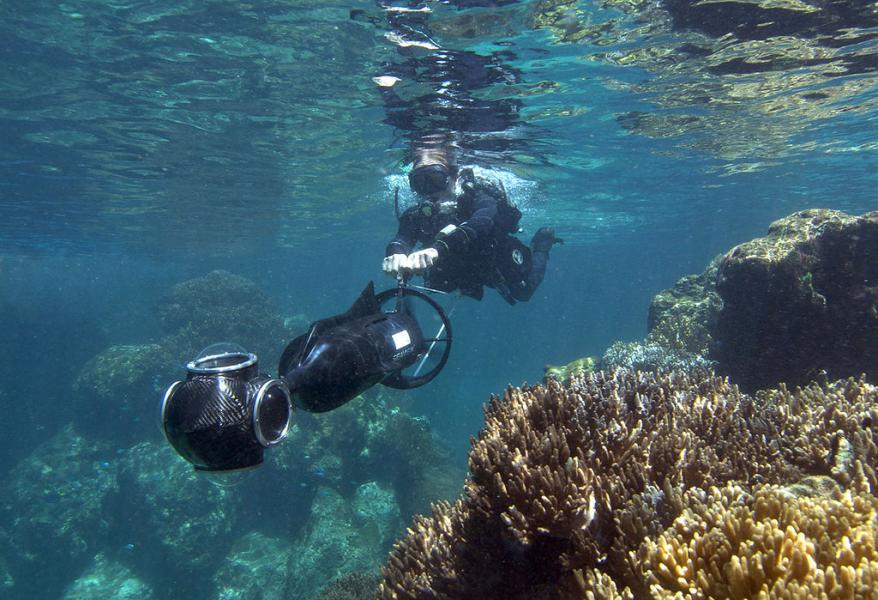
Thanks to a partnership with The Catlin Seaview Survey, Google Maps now displays Street View-ish images of the Great Barrier Reef and popular underwater spots around Hawaii and the Philippines. Clear your calendar. Forward your emails. It’s time for an undersea adventure.
As Google explained in a blog post today (now pulled) you can now use Google Maps to swim with a turtle, follow a manta ray or lose yourself watching the sun set over a reef. You can go diving in Maui’s Molokini crater or join snorkelers in Oahu’s Hanauma Bay. And of course all this is possible without swim lessons or sunscreen thanks to the magic of Google Maps.
The video below shows how the amazing imagery was captured. Using a special one-off camera called the SVII, divers for The Catlin Seaview Survey swam at 4 kilometers an hour to capture the stunning footage.
Right now the imagery is very limited. Outside of the links above, it’s rather difficult to find an area to go swimming. Seaview spots are marked with an orange circle that’s only revealed when the Street View icon is dragged onto the map. Even then, these spots only show up when the map is zoomed in nearly all the way. It seems Google announced this service a bit prematurely.
Google pulled the announcement post shortly after it went live. Several of the outbound links — to maps.google.com/ocean and The Catlin Seaview Survey — do not resolve at the time of this article’s posting. A much larger rollout is likely in the books.
But the data is still in the maps right now. You can still leave your cubical behind and explore ancient boulder coral at Apo Island within a Philippines marine reserve. Who needs a vacation when you have Google Maps.


Sunday, September 2, 2012

Video: Reality Of Human Flight – Wingsuit, Tracksuit Flying

Video: Reality Of Human Flight – Wingsuit, Tracksuit Flying:


Man this looks fun. GoPro HD athlete Alexander Polli tests the limits of human flight with insane proximity wingsuit and tracksuit dives along the landscapes of New Zealand, Switzerland, and Norway.
Video: Reality Of Human Flight – Wingsuit, Tracksuit Flying is a post by on Highsnobiety.

Bamford Watch Department Rolex Datejust

Bamford Watch Department Rolex Datejust:
Bamford Watch Department Rolex Datejust
Bamford Watch Department has just released images of its latest custom watch and it looks to be an absolute stunner. Starting with a standard Rolex Datejust, the company has applied its signature black PVD coating to the watch and has topped it off by adding gold markers and hands for the dial. More subtle than some of the company’s recent customs, this just might be the cream of the crop. For Further information and to inquire about the watch, check Bamford’s website.


Source: ACQUIRE
Read more at Hypebeast.com


Thursday, August 30, 2012

Scanning Your Home With Kinect Could Improve 3-D Robot Vision

Scanning Your Home With Kinect Could Improve 3-D Robot Vision: Seeking a way to crowdsource better computer vision, roboticists have launched Kinect@Home, a website that allows users to record pieces of their environments in 3-D with a Kinect camera. Should the project catch on, researchers may be on the cusp of an unprecedented way to amass 3-D data to improve navigation and object-recognition algorithms that allow robots to cruise and manipulate indoor environments.

Friday, August 24, 2012

Another Step Closer to Star Trek Replicators

Another Step Closer to Star Trek Replicators:

The Imagine 3D Printer by Essential Dynamics is inching us ever closer to 3D printing as a commercial option for regular households. And this one can print food.
In fact, it can print just about anything. From the site itself:
If you can bring it to a soft form first (using a household blender), you can print with it. The sky is the limit.
Starting to sound like we’re getting closer to Replicators!
Apparently, since this printer uses syringes instead of the regular hot plastic extrusion pieces found on other 3D printers, it can print things at room temperature – such as food! According to an interview with Stevie Green, Essential Dynamics Sales Manager, over at Fabbaloo they’ve tested the printer with chicken, fish, turkey, beef and pork, blending it and then shoving it in the cartridge.
This could mean some very extravagantly designed fine-dining options for chefs, but it also means intricate work can be performed on cakes and other sweet delicacies. Truly edible art is a real possibility with this.
Here’s a video “demonstrating” it, but exactly what it’s making…I have no idea.

The product boasts the “largest build tray in the industry” at 9″ by 9″, is designed to be lightweight and portable and, most importantly, affordable – it only costs $1,995, which is actually more reasonable than I thought it would be. Seems pretty cool, anyone tried one out by any chance?
[Via Geek.com]
No related posts.

17 Of Our Favorite Breakfast Sandwiches in NYC

17 Of Our Favorite Breakfast Sandwiches in NYC:
From Serious Eats: New York


Slideshow

VIEW SLIDESHOW: 17 Of Our Favorite Breakfast Sandwiches in NYC


What is it about breakfast sandwiches? They're always just what you wanted, and they're so much better than just plain breakfast. Whether they feature melted cheese or a runny yolk, they're almost always oozing with warm and gooey yellow deliciousness, all caught in the crumb of two pieces of bread, biscuits, English muffins, and other starchy cradles. In our continued celebration of National Sandwich Month, here are 17 of our favorite breakfast sandwiches, each so good you'll be looking forward to your alarm going off in the morning.


Will Oculus Rift Be Next iPhone-Like Revolution?

Will Oculus Rift Be Next iPhone-Like Revolution?: Will Oculus Rift Be Next iPhone-Like Revolution?Valve talks about what needs to be done to jump-start virtual reality like the iPhone did with the smartphone sector.

Tuesday, August 21, 2012

Apps Are Not Coffee

Apps Are Not Coffee: Jameson Ahern points us to a fantastic discussion by Josh Lehman, explaining why it's silly to argue that people are irrational for spending $4 or more on a cup of coffee*, but not $0.99 on digital content or apps. As with nearly all cases of seemingly "irrational" behavior in economics, the truth is that you just need to better understand the marginal benefit that people are getting and the true marginal costs, which often go way beyond the dollar amount. Lehman points out a few key examples, with the focus on trust & certainty, as well as the difference in the competitive market.


For the first point, he notes that you know exactly what you're getting with a Starbucks cup of coffee and how much you'll enjoy it:

I know I’ll like my cup of coffee. It will fully meet my expectations. For the $4 I spend I don’t expect it to change my life. I don’t expect it to even last beyond its last drop (and a trip to the bathroom later). It’s an experience I can fully trust will be pretty much the same each time. There’s no gamble here. Ask me if I’d like to drop $4 on a cup of your new “Instant Refresher Juice 1.0″ and there’s a very good chance I’ll pass. Or, maybe I’ll ask for a free sample to see if your $4 Instant Refresher Juice 1.0 is as good as Starbucks Coffee. In short, I know what I’m getting for $4 and I’m getting that same experience every time I hit the drive thru.
What he's really pointing out here is that there's a much bigger cost to your content than just the $0.99 it's being offered for. It's the risk of not getting any actual value out of it. And since people are, quite naturally, loss averse, they're much more hesitant to spend under such circumstances. This is completely rational behavior.


He also points out the general nature of the market, and whether or not there are reasonable "free" alternatives:

When you walk up to the counter of your local coffee shop you are not asked, “would you like a cup of our free coffee, or would you like to select from our paid options?”. If Starbucks gave out free coffee every day there would be mile-long lines at the drive thru. If the free coffee was anywhere close to as good as their paid stuff people would abandon the paid en masse. Some would pay maybe because they felt bad, as a freeloader. Others would pay because they preferred the options available to them in the paid column vs. the free. Now imagine the free selection at starbucks was nearly as large, or larger, than the paid selection: Welcome to the App Store.
In other words, as we've explained for years, the nature of the wider market really matters. In competitive markets, price gets driven down towards marginal cost. There are ways to prevent that -- and one is to build up brand value through things like trust and certainty (see the point above). So while there are cheaper alternatives, or even in many cases "free" alternatives at people's workplaces (contrary to Lehman's suggestion that there are no such alternatives), people still flock to the one they know and trust. But if there are lots and lots and lots of free alternatives, then you have to work much harder to justify the price. In some cases, for some people, you can. But the market situation between coffee and apps is not very close at all.


Lehman makes some other points as well, but the key one is that these are totally different markets with different factors playing on pricing. Comparing them in absolute dollar terms misses the full costs and full benefits associated with the purchase.


* Moreover, despite the "$4 coffee" being an oft-repeated trope about Starbucks, it's not really true. The biggest cup of coffee at Starbucks costs a little over $2. The drinks that are pricier than that are generally about nine-tenths milk, and milk is much more expensive than coffee. Indeed, the drinks that so many people think are a "ripoff" are not where Starbucks makes the majority of its money—they tend to be much lower-margin items than the plain coffee, because milk and whipped cream and fancy syrups are all high-cost and expensive to store. Is Starbucks still "expensive"? Maybe so -- but anyone who opens that discussion by talking about the "$4 cup of coffee" demonstrates a fundamental misunderstanding of how the business functions (and even of what's on the menu).

Permalink | Comments | Email This Story


Wednesday, August 15, 2012

Crowd Control: Cool Time Lapse Shows How People Gather

Crowd Control: Cool Time Lapse Shows How People Gather: [ By Delana in Art & Photography & Video. ]

Crowd-watching is one of those perennial favorite activities that never seems to get old no matter how often you do it. For the 2011 Vancouver Celebration of Light, a popular annual fireworks show, Dave Delnea Images documented the huge crowd gathering, reveling and then dispersing.
The video produced by the firm shows a vibrant crowd flocking to the beach to watch the light show. From the high vantage point, each of the individuals melds into a part of the larger throng.

The fabric of the crowd weaves itself into a colorful tapestry that writhes and undulates, never sitting still.

This short video is a perfect examination of the energy of city life; the urban landscape is enhanced and defined by the people who inhabit it.

[ By Delana in Art & Photography & Video. ]

[ WebUrbanist | Archives | Galleries | Privacy | TOS ]